How to Get Your Business Found on AI Search in 2026
The way people find businesses has changed more in the past 18 months than in the previous decade. A growing number of founders, buyers, and decision-makers are no longer typing queries into Google and scrolling through a list of blue links. They're opening ChatGPT, Perplexity, Gemini, Google AI Overviews, and Claude and asking direct questions — and they're acting on the answers those platforms provide.
ChatGPT now has over 800 million weekly users. Perplexity handles 780 million monthly queries. Google AI Overviews appear in up to 60% of searches. The shift is not coming, it is already here.
Gartner predicts traditional search engine volume will drop 25% by 2026, with AI chatbots and virtual agents capturing that share. Early adopters of AI search optimization report that 32% of their sales-qualified leads now come from generative AI search, compared to virtually none just months ago.
If your business isn't showing up in AI-generated answers, you're invisible to a segment of your most valuable potential clients — and that segment is growing fast. This guide covers exactly what AI search is, why it works differently from Google, and what to do to show up consistently across every major platform.
what is ai search & why does it matter for your business
Traditional search works by ranking web pages. You type a query, Google returns a list of results, and you click through to find what you need. AI search works fundamentally differently. Instead of presenting a list of links, platforms like ChatGPT, Perplexity, Gemini, Google AI Overviews, and Claude synthesize information from multiple sources and deliver a direct answer, often without requiring a single click.
This changes everything about how businesses get discovered.
In traditional search, ranking on page one gets you visibility. In AI search, being cited in the answer is the only visibility that matters. 60% of searches already end without a click, and click-through rates to position one have fallen to just 2.6%. The businesses that show up inside AI-generated answers are the ones that get the attention, the trust, and ultimately the inquiry.
The discipline of optimizing for AI search is called Generative Engine Optimization, or GEO. Unlike traditional SEO which focuses on ranking in search engine results pages, GEO optimizes content to be cited as an authoritative source by large language models. It is an extension of SEO, not a replacement for it, but it requires a different set of decisions.
Research shows that 87% of ChatGPT citations match Bing's top 10 results, and 93.67% of Google AI Overview citations link to at least one top-10 organic result. GEO is an extension layer on top of SEO, not a replacement. Brands with strong SEO foundations see the fastest GEO results.
The practical implication is this: getting your SEO fundamentals right still matters. But it is no longer sufficient on its own.
5 ai search platforms your business needs to show up on
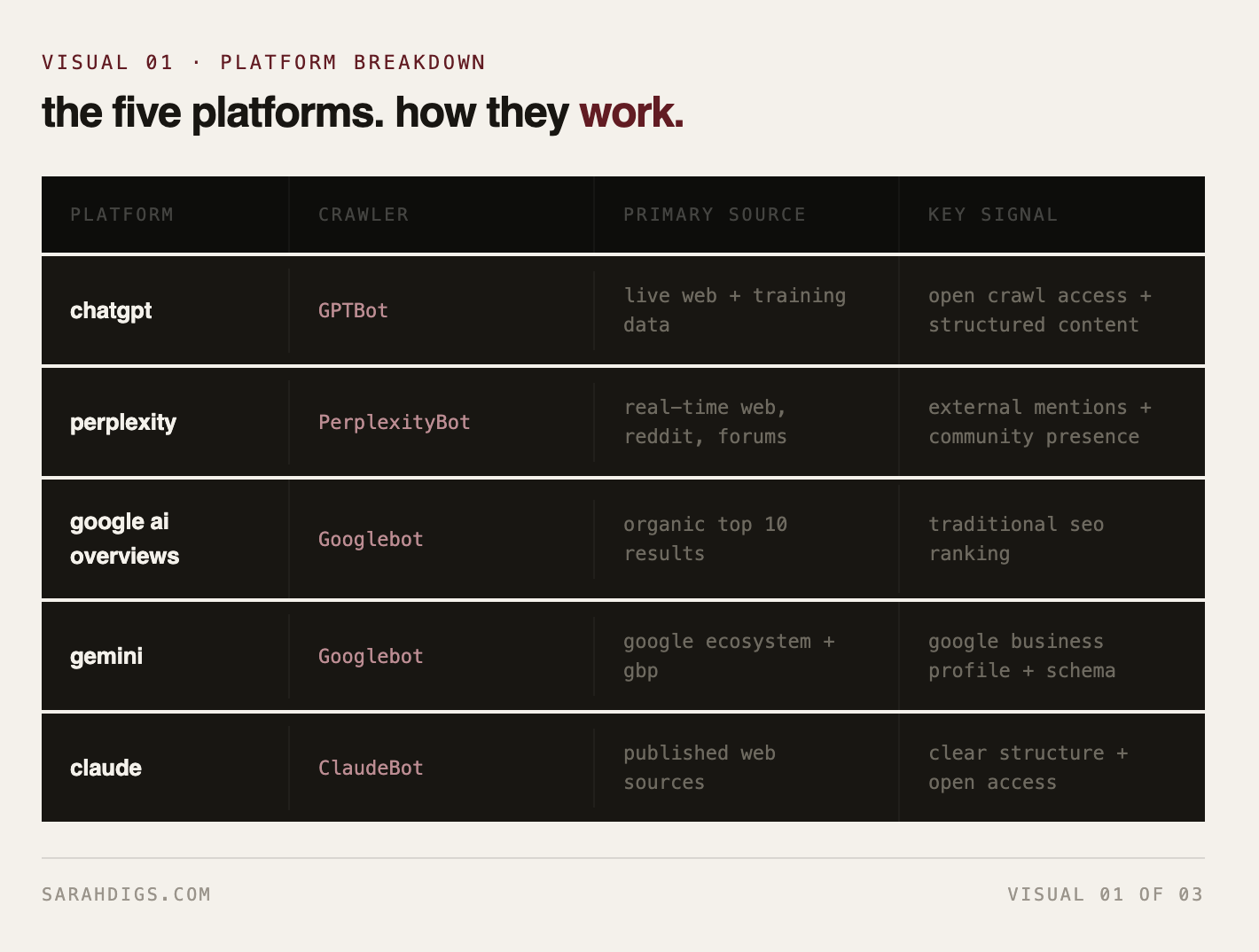
Not all AI search platforms work the same way. Each one pulls from different sources, uses different crawlers, and applies different logic when deciding which businesses to surface. Understanding how each one works is the first step to showing up on all of them.
ChatGPT ChatGPT uses a crawler called GPTBot to index web content. When browsing is enabled, it pulls from live web sources. When it isn't, it draws from its training data. ChatGPT drives 87.4% of AI referral traffic to websites, making it the single most important platform for AI search visibility right now. Pages that are clearly written, well-structured, and openly crawlable have the highest chance of being cited.
Perplexity Perplexity is a real-time AI search engine that crawls the web continuously using PerplexityBot. It heavily references community platforms like Reddit, forums, and industry publications alongside traditional websites. A business that only exists on its own website has a significantly lower chance of appearing in Perplexity answers than one with a broader web presence.
Google AI Overviews Google AI Overviews sit directly inside Google search results. They use Google's existing crawling infrastructure, which means Googlebot is the relevant crawler. 99% of AI Overview citations come from the organic top 10. Strong traditional SEO is the primary driver of Google AI Overview visibility, making this the platform most directly connected to existing search rankings.
Gemini Gemini is Google's AI assistant and draws heavily from Google's own ecosystem — Google Business Profile, YouTube, Google Maps, and web-indexed content. For local and service businesses, having a complete and accurate Google Business Profile is one of the most direct levers for Gemini visibility.
Claude Claude uses ClaudeBot to crawl web content and draws from a wide range of published sources. Like the other platforms, it prioritizes content that is clearly structured, specifically written, and openly accessible. Blocking ClaudeBot in your robots.txt file removes your site entirely from its consideration.
why most business websites are invisible to ai search
Most businesses assume that if their website is live and indexed by Google, it's visible everywhere. That assumption is wrong and it's costing them discovery across every AI platform.
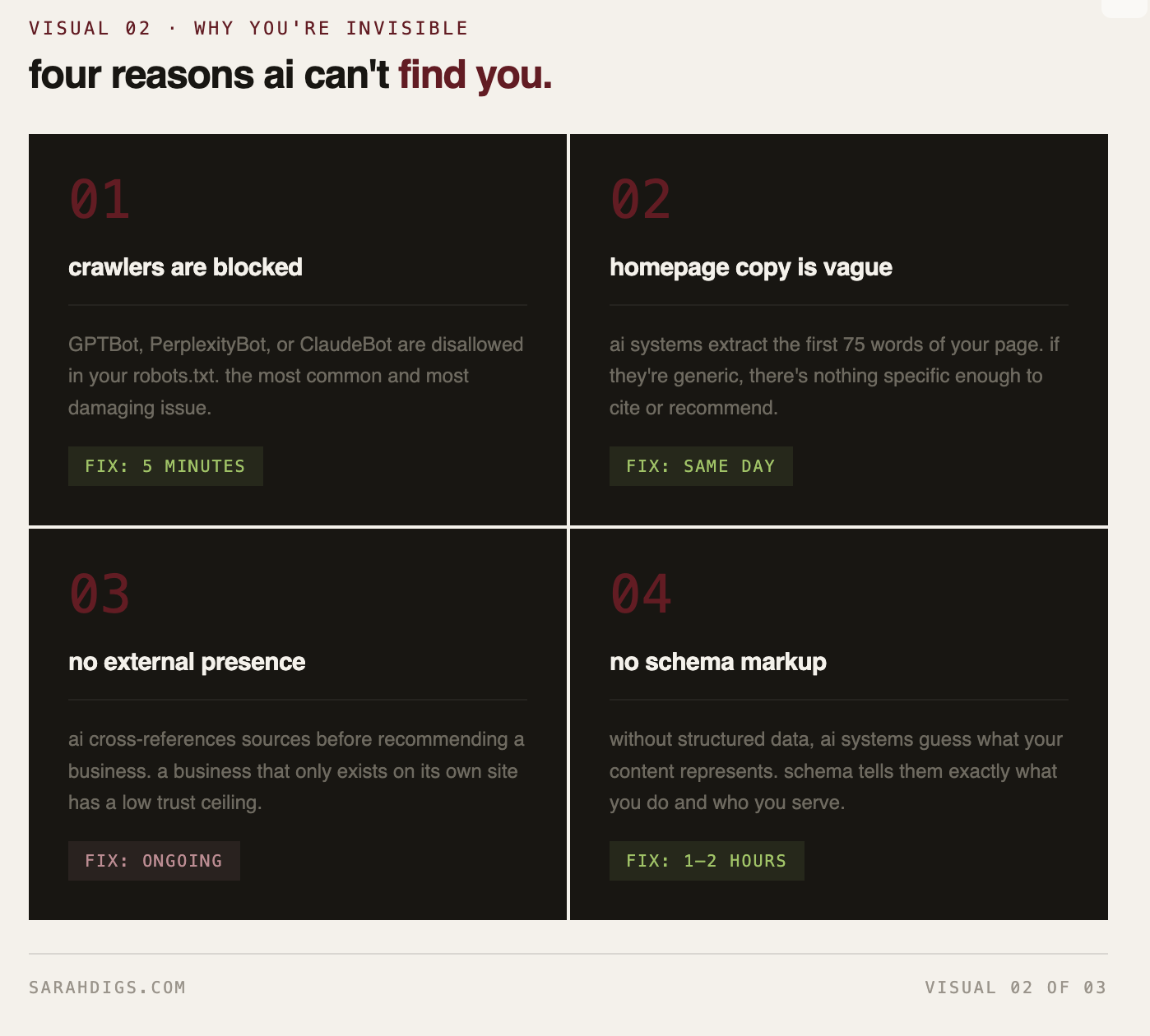
There are four reasons a business website is typically invisible to AI search, and most of them are fixable within a day.
blocked crawlers Every AI platform uses its own crawler. If your robots.txt file blocks GPTBot, PerplexityBot, or ClaudeBot, those platforms cannot read a single page on your site. This is the most common and most damaging issue. A business can have exceptional content and a well-ranked website and still be completely invisible to AI search because of three lines in a text file.
vague homepage copy AI search engines extract specific, clear information from the opening sections of web pages. A homepage that opens with a tagline like "we craft digital experiences that elevate brands" gives AI systems nothing concrete to work with. No service category. No audience. No outcome. Nothing citable.
no external presence AI platforms cross-reference information across multiple sources before recommending a business. A business that only exists on its own website has a much lower trust ceiling than one that appears consistently across LinkedIn, industry publications, directories, and community platforms.
missing structured data Schema markup tells AI systems exactly what your content represents. Without it, platforms have to guess. 86% of AI citations come from brand-managed sources that businesses of any size can control. Schema is one of the most direct and controllable signals available.
For a full practical walkthrough of how to diagnose and fix each of these issues, read: [is your website invisible to ai search? here's how to check]
what ai search engines look for on websites
Understanding what AI platforms are trying to extract from your content makes every other optimization decision clearer. AI search engines are not reading your website the way a human does. They are scanning for specific signals that help them understand what your business does, who it serves, and whether it's trustworthy enough to recommend.
The signals that matter most are:
clarity in the opening content The first 40 to 75 words of any key page are the most important. AI systems prioritize content at the top of the page when extracting information. If your homepage, services page, or about page opens with anything vague, poetic, or abstract, you are giving AI systems a weak signal at the exact moment they need a strong one.
specific service & audience descriptions AI platforms need to understand not just what you do but who you do it for. "Website design" is vague. "Strategy-led website design for early-stage tech companies" is specific enough to cite when someone asks "who builds good websites for startups."
structured content Pages with structured lists, quotes, and statistics have 30 to 40% higher visibility in AI responses. Leading with answers and putting key information at the beginning of each section rather than burying it under paragraphs of context significantly increases the chance of being extracted as a citation.
consistent information across platforms AI systems build confidence by cross-referencing. When your business description, service offering, and audience are consistent across your website, LinkedIn, Google Business Profile, and any publications that mention you, AI platforms can recommend you with confidence. Inconsistency creates doubt.
For a deeper breakdown of exactly what AI search looks for page by page, read: [what AI search actually looks for on your website]
how to write content that ai search engines reference
The way content is written has a direct impact on how frequently it gets cited by AI platforms. This is where generative engine optimization diverges most clearly from traditional SEO writing.
Traditional SEO content is often written to satisfy search intent through depth, keyword density, and topical coverage. AI-optimized content needs to do all of that and also be structured so that specific answers are immediately extractable.
The most important writing principles for AI search visibility are:
lead with the answer Every section should open with its conclusion, not build toward it. AI systems scan for direct, extractable statements. If the answer to a question is buried in paragraph four, it will be missed. State the key point first, then support it.
write in clear, declarative sentences: Short paragraphs of two to three sentences maximum are easier for AI to parse and more likely to be extracted as a citation than long blocks of text. Write as if every paragraph needs to stand alone and make complete sense without the surrounding context.
use FAQs strategically: FAQs are among the most cited content formats in AI answers because they directly mirror how people ask questions of AI platforms. A well-written FAQ section that answers the specific questions your ideal client is asking is one of the most reliable ways to increase citation frequency.
include specific data and outcomes Content that includes quotations increases AI visibility by 41%, statistics by 32%, and citations by 30%. Specific numbers, named outcomes, and referenced sources are significantly more likely to be extracted and cited than general statements.
For a full guide on writing website copy specifically for AI search visibility, read: [how to write website copy that AI search engines reference]
how ai search is changing what your homepage needs to do
The homepage has always been the most important page on a business website. In the context of AI search, its importance has increased further — and its job description has changed.
A homepage used to need to do three things well: communicate what the business does, build enough trust for someone to keep exploring, and point visitors toward the next step. Those three things still matter. But there is now a fourth requirement that most homepages completely ignore: being readable and extractable by AI systems.
An AI search engine landing on your homepage is making a fast decision about whether your business is relevant enough to recommend. It's looking for a clear category, a specific audience, named outcomes, and consistent language it can confidently surface in an answer.
Most homepages fail this test because they were designed entirely for human visitors and not at all for machine extraction. The design is strong. The copy is polished. But the specific, direct information that AI systems need is buried under layers of brand language and visual hierarchy that a crawler cannot read.
The good news is that making a homepage AI-readable does not require rebuilding it. In most cases it requires rewriting the first section to be more specific, adding clear structured headings, and ensuring the page opens with a direct statement of what the business does and who it serves.
For a complete breakdown of what needs to change and what doesn't, read: [how AI search is changing what a homepage needs to do]
a practical action plan for ai search visibility
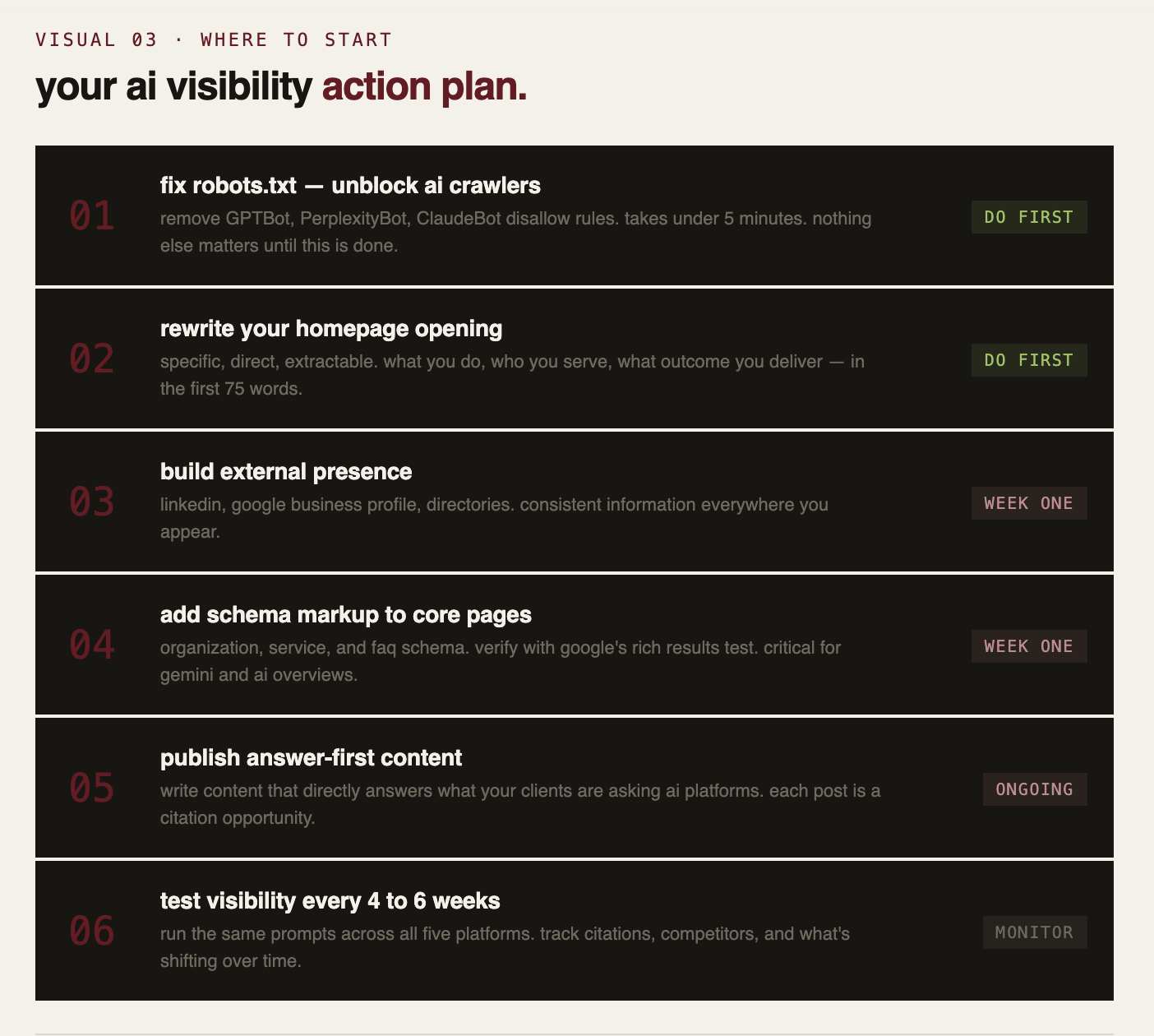
Getting visible on AI search is not a single task. It is a sequence of decisions made in the right order. Here is the priority order that produces the fastest results on a new or under-optimized website.
first — fix your robots.txt file Check whether GPTBot, PerplexityBot, and ClaudeBot are blocked. If they are, remove the disallow rules. This is the highest-impact change available and takes under five minutes. Nothing else matters until crawlers can access your site.
second — rewrite your homepage opening The first 75 words of your homepage should clearly state what your business does, who it serves, and what outcome it delivers. Specific beats clever every time for AI visibility.
third — build your external presence Update your LinkedIn company page. Complete your Google Business Profile. Ensure your business description is consistent everywhere you appear. Get mentioned in at least one external publication, directory, or community platform relevant to your industry.
fourth — add schema markup Add Organization, Service, and FAQ schema to your core pages. Use Google's Rich Results Test to verify it's working correctly. This directly improves visibility on Google AI Overviews and Gemini.
fifth — create answer-first content Start publishing content that directly answers the questions your ideal clients are asking AI platforms. Each piece of content is an opportunity to be cited. Structure every post so the answer comes first and the supporting context follows.
sixth — test and measure Run the same bottom-of-funnel prompts across ChatGPT, Perplexity, Gemini, Google AI Overviews, and Claude every four to six weeks. Track which platforms are citing you, which competitors are appearing, and what's changing over time. AI citation frequency, brand representation accuracy, and share of voice in AI answers are the metrics gaining traction for measuring GEO performance.
the window is open but it won't stay open
By early 2026, most enterprise marketing teams already have a GEO initiative in place. Most small and mid-size business teams have not started yet. This gap creates a significant first-mover opportunity — but it is closing.
The businesses that show up consistently in AI search answers right now are not there by accident. They made deliberate decisions about how their websites are structured, how their content is written, and how consistently they appear across the web. Those decisions are compounding. Every piece of content published, every schema tag added, every external mention earned makes the next citation easier to get.
Traffic from AI platforms converts at significantly higher rates than traditional search, with some studies showing conversion rates five times higher than organic search. The businesses getting that traffic now are building an advantage that will be significantly harder to close in twelve months than it is today
AI search visibility is not a future problem to solve when it becomes urgent. It is a present opportunity to capture before everyone else figures out it exists.